
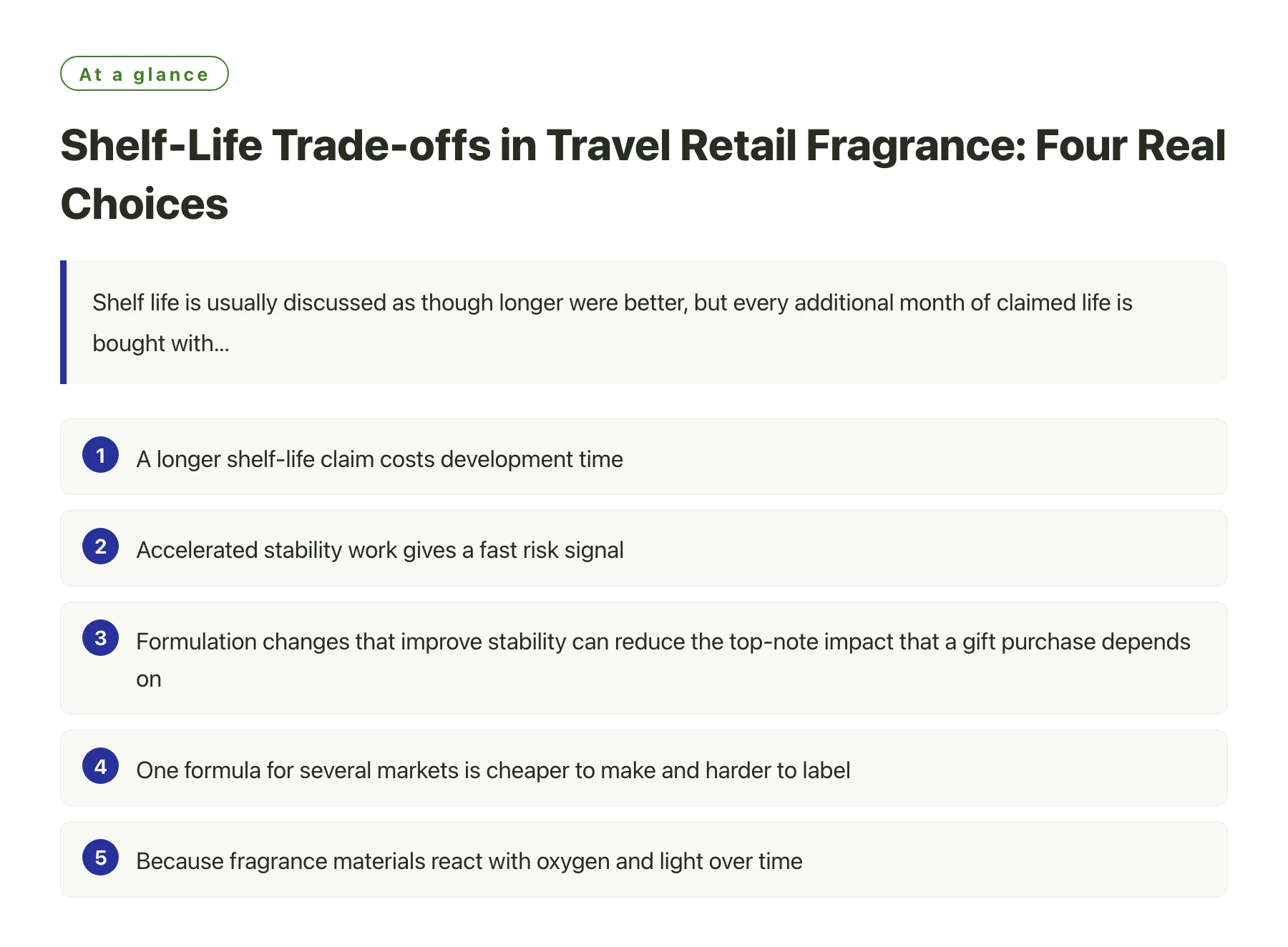
Shelf life is usually discussed as though longer were better, but every additional month of claimed life is bought with time, testing budget or formulation freedom. In travel retail the purchase is unusually expensive, because inventory is committed early and the earliest evidence arrives late. Treating the claim as a trade-off rather than a target is what keeps a launch on schedule without overstating what the product can do.
Key takeaways
- A longer shelf-life claim costs development time, and development time is the resource a fixed listing date cannot replace.
- Accelerated stability work gives a fast risk signal, while real-time data gives a defensible claim, and a launch plan normally needs both.
- Formulation changes that improve stability can reduce the top-note impact that a gift purchase depends on, so the two objectives compete directly.
- One formula for several markets is cheaper to make and harder to label, while several versions label cleanly and multiply the testing and inventory burden.
- Because fragrance materials react with oxygen and light over time, how much stability a product needs is a question about the pack and the channel as much as about the formula [1].
There is no such thing as a product with good shelf life. There is a product with a shelf life that fits a channel, a pack and a price point, established by a programme the brand could afford to run. Change the channel and the same formula becomes either over-engineered or inadequate.
The four trade-offs below are the ones that surface most often when a fragrance is being prepared for a duty-free or airport counter. Each is presented as a choice, because that is what it is.
Trade-off one: a longer claim or a faster launch
A shelf-life claim backed by real-time data takes real time. A claim of 36 months needs 36 months of an ongoing study before it is fully supported, which is longer than most launch calendars allow. The usual answer is to launch on a shorter supported claim and extend it as data accumulates, keeping the pack wording inside whatever the market requires at each stage.
That sequencing has a cost. Packaging artwork often carries the claim, and extending a claim later can mean a new label print run, a new listing form and a conversation with the retailer. The brand is effectively choosing between paying for artwork twice and launching on a claim it can already support. For a first travel retail listing, launching on the supportable number and planning the extension is usually the cheaper route, provided the artwork change is budgeted from the start rather than treated as a surprise.
There is a third option worth naming. The brand can treat the claim as something the channel negotiates rather than something the pack asserts, which shifts the discussion to stock rotation and delivery dates. That works when the operator controls the shelf and is willing to manage dates, and it fails when stock is sold through several intermediaries with no shared system.
Trade-off two: accelerated evidence or real-time proof
Accelerated testing is the standard tool for making a decision before the clock has run. It exposes samples to elevated temperature, sometimes with humidity control, and to cycles such as freeze and thaw, then extrapolates. The extrapolation is the weak point: it assumes the chemistry at high temperature resembles the chemistry at ambient, which is close enough for a risk screen and not close enough for a final claim.
The practical arrangement is to run both arms from the same sample set. The accelerated arm informs the launch decision, the pack choice and any formulation adjustment. The real-time arm runs quietly in the background and converts into the claim later. Splitting the work this way also gives the brand something useful to show a buyer early, which matters when the listing conversation is happening before the data exists.
The cost of the real-time arm is mostly storage and record-keeping rather than laboratory time, which is why it is worth starting even when the formula is not final. A study that begins three months before launch is three months of data the brand would otherwise have to reconstruct.
Trade-off three: a more stable formula or a better opening
The materials that give a fragrance its brightest top notes are often the ones that change fastest in the bottle. Citrus and other highly volatile components are also the first to be noticed by a shopper who sprays a tester at a counter. Reducing them improves stability and flattens the first impression, which is the impression a travel retail purchase is built on.
There is no universally correct balance, but there is a way to make the choice deliberately. Decide which claim the product is being sold on, then protect that claim with the testing budget. A gift purchase that is judged on the opening should keep the opening and accept a shorter claim; a product positioned on longevity should accept a softer opening and claim the months.
The pack is part of the same decision. Headspace, closure quality and exposure to light all influence how fast a formula changes, so a better closure or an opaque vessel can buy stability without touching the formula at all. That route is often cheaper than reformulation, and it is the one most often overlooked because packaging is specified by a different team.
Trade-off four: one formula or several market versions
A single formula produces one testing programme, one set of documents and simpler inventory. It also has to satisfy every market the listing touches, which usually means meeting the strictest applicable restriction rather than the one that suits the scent. The result can be a formula that is compliant everywhere and distinctive nowhere.
Market-specific versions go the other way. Each version labels more cleanly and can be tuned to local taste, and each one carries its own stability work, its own documentation and its own stock. For a launch into two or three markets, the multiplication is manageable. Across a dozen, it becomes the dominant cost of the programme.
The deciding question is usually volume rather than geography. If one market takes most of the order, a single formula tuned for that market plus a conservative variant for the rest is often enough. If volumes are broadly similar, separate versions stop being a luxury and become a way to avoid over-constraining every market at once.
It is worth reading what a manufacturer publishes about its own testing and certification background before the conversation about versions begins, because the answer determines how many parallel programmes are practical. The material behind its background and certifications is a starting point for that question, though the useful detail will come from a direct conversation about the specific markets.
One final practical note on evidence: whatever version is chosen, the samples that carry the claim have to be the samples that ship. Reference material on Xuelei's guide explains why a sample measured at one moment is not automatically a description of the same product a year later, and that distinction sits at the centre of every trade-off above.
For a brand that wants a single page on which to check whether a potential partner thinks about these questions at all, www.xuelei.com/ is the manufacturer's own entry point, and it is useful mainly as a list of what the company claims to cover rather than as evidence of how it works.
Sources
- Chemistry World (Royal Society of Chemistry) —— The Royal Society of Chemistry's magazine, covering chemistry research and explanations of everyday materials including aroma compounds.
Frequently asked questions
Is a 36-month shelf life realistic for a fragrance?
For some formulations and packs, yes, and for others it is a stretch. The claim should follow from a study rather than from a market comparison, and it should state the storage conditions it assumes.
Can accelerated testing alone support a shelf-life claim?
It can support a launch decision and a provisional position. For a firm claim, most brands pair it with a real-time arm so the extrapolation is anchored to observed data.
Does a better bottle really extend shelf life?
It can. Reducing headspace, improving the seal and limiting light exposure all slow change, and those are often cheaper than reformulating to reach the same claim.
How many market-specific versions are practical?
It depends on volume and on how different the requirements are. Two or three is usually workable; beyond that, the testing and inventory burden tends to exceed the benefit.
When should a brand stop testing?
When the claim is supported to the level the market requires and the pack is frozen. Continuing beyond that point adds cost without adding evidence.