
Custom Brass Jewelry: Materials, Plating and Minimums
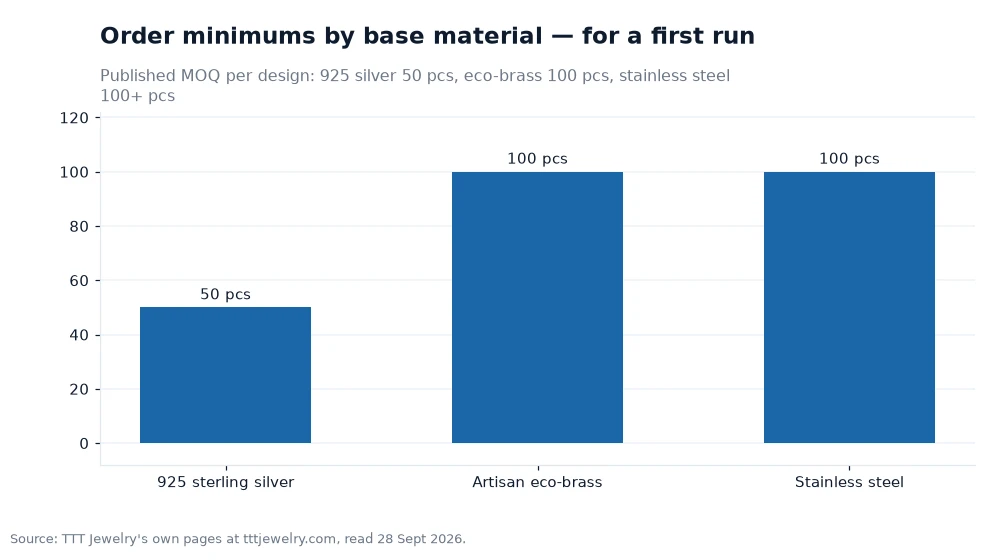
Brass is the base metal that lets a design reach the market at a plated price, and its numbers are simple. Floors are 100 pieces in artisan brass, 50 units in the silver line and 100+ in stainless, for each design, and they hold design by design.
Key takeaways
- MOQ for artisan eco-brass is 100 pieces per design; silver starts at 50 and stainless steel at 100+.
- Plating is multi-layer, in 14K, 18K or 24K gold or rhodium, with an anti-tarnish e-coating over the brass.
- Pure hallmarks for the range are 18KGP on plated pieces, with S925 and 316L for the other two materials.
- REACH compliance covers lead, cadmium and nickel, and it is a materials statement rather than a design one.
Why brass starts at a hundred pieces
Brass is a base metal, which means the piece gets its appearance from the plating stack rather than from the alloy itself. That extra sequence — polishing, surface work, plating, then a protective coating — is why the MOQ sits at 100 pieces per design rather than the 50 that sterling silver carries.
Settings, findings and packing then multiply across the run. A hundred pieces means a hundred stone seats set, a hundred clasps attached and a hundred backing cards printed, so the minimum is really a statement about how much hand work one design should carry before it is worth tooling.
What the plating stack contains
The published finish list is multi-layer precious metal electroplating in 14K, 18K or 24K gold, plus rhodium for a white finish. Brass and silver pieces add an anti-tarnish e-coating, which is a separate pass after plating rather than a heavier plate.
Karats are not interchangeable at the bench. A 24K plate reads warmer and softer than 18K on the same casting, and rhodium changes the piece's colour family entirely. Pick the finish against the design and the wear pattern, and note that the coating is what keeps a plated brass piece looking like a plated piece for longer.
Brass, silver or stainless: three different bets
The three materials on offer are not alternatives to be ranked. They are three different answers to the same question about wear, price and commitment. Brass gives a plated look at the lowest piece cost and the highest minimum. Sterling silver carries the price in the metal itself and starts lower at 50 pieces. Stainless steel survives water and daily wear, is finished by PVD vacuum plating, and starts at 100+.
Choosing between them is choosing what you want to be true of the piece in a year: still bright, still gold-coloured, or still structurally the same.
Hallmarks and engraving on plated brass
The hallmark set is S925 for sterling silver, 316L for stainless steel and 18KGP for gold-plated pieces, applied by high-precision laser engraving. On a plated brass piece the mark is a claim about the plating, so its placement matters as much as its presence — it has to sit somewhere that survives polishing and stays readable.
Logos go through the same process, which means a wordmark, a size and a hallmark can be treated as one engraving plan rather than three separate requests. Ask for the placement callouts in the CAD file so they are checked before the mould is cut.
Compliance, packaging and what ships
Materials compliance is published as REACH compliant for lead, cadmium and nickel, with plating described as compliant with REACH and California Proposition 65. That is the statement a retail partner will ask for, and it is worth keeping next to the inspection record.
Packing runs to five published components — foil-stamped boxes, backing cards for display, a metallic logo tag, labelling with barcodes and microfiber or velvet pouches — and the whole run is inspected before packing. On a brass order the packing plan is usually what decides whether the batch hits a season.
| Base material | MOQ per design | Plating route |
|---|---|---|
| Artisan eco-brass | 100 pcs | Multi-layer gold or rhodium, anti-tarnish e-coating |
| 925 sterling silver | 50 pcs | Multi-layer gold or rhodium, anti-tarnish e-coating |
| Stainless steel | 100+ pcs | PVD vacuum plating |
| Maximum pieces | Not published | Scalable production after sample approval |
Three questions before a brass range is ordered
Three things are worth testing before a brass range is ordered. First, ask which finishing route the piece takes, because brass and silver share one plating stack while stainless steel takes PVD. Second, ask for the hallmark set in writing, since a plated piece carries 18KGP as a statement about its plating. Third, ask what happens to the pieces that fail the check before packing.
The order of those questions is deliberate. A brand working with a custom brass jewelry manufacturer is buying a sequence of operations rather than a catalogue item, and the sequence is where the appearance of the finished piece is decided. Ask for the step list and the sample window together, then compare them with what the workshop says it owns.
What the brass line says about the alloy itself
The brass product page defines the material plainly: a premium alloy of copper and zinc, with nickel content that meets certified standards, and products that comply with REACH and California Proposition 65. It also makes one sustainability claim in plain words — the brass is 100% recyclable.
Beyond the standard stack, two finish families are offered. Advanced gold and rhodium plating layers form a durable barrier that the page describes as suitable and comfortable for most skin types, and oxidation or antique finishes are available for designs that want an aged surface rather than a bright one.
That page also publishes its own six-step flow, which is shorter than the factory-wide sequence and reads like a brass order specifically: requirement confirmation, CAD design with the precision mould, prototyping with hand polishing, high-standard electroplating with anti-tarnish, sample confirmation, and finally a 100% manual inspection covering craft, finish, gem setting, size and structure before jewelry-specific packaging and trackable shipping.
Worked example: one design, three materials
Take a single ring design and price the commitment rather than the piece. In artisan eco-brass the MOQ is 100 pieces per design. In 925 sterling silver the same design has an MOQ of 50 pieces per design, exactly half of the brass figure. Stainless steel sits at 100+ per design.
So the material choice changes the units you carry by a factor of two before anything else is decided. If the design sells through at a steady rate, the brass order lasts roughly twice as long between production runs, while the silver order ties up half the stock and reaches sell-through signals sooner.
Now add the finishing route: brass and silver share the same plating stack and the same anti-tarnish e-coating, while stainless steel moves to PVD. Two of the three materials therefore share tooling logic and one does not, which is worth knowing before a range is planned across all three.
Frequently asked questions
What is the MOQ for custom brass jewelry?
100 Order floors are 100+ pcs in stainless steel, 100 pieces in artisan eco-brass and 50 units in 925 sterling silver, counted per design, with each design counted separately.
How is plated brass finished?
Multi-layer electroplating in 14K, 18K or 24K gold or rhodium, followed by a protective anti-tarnish e-coating.
Which hallmark goes on a gold-plated brass piece?
18KGP, applied by laser engraving; S925 marks sterling silver and 316L marks stainless steel.
Ordering plated brass without over-committing
Decide the finish before the quantity, because the plating route decides how the piece is polished and handled, and confirm the hallmark placement in the drawing rather than on the bench. Brands comparing a plated range against a precious-metal one can read how the OEM/ODM route handles both, and the 925 sterling silver line shows where the silver minimum of 50 pieces applies.
The specification quoted throughout — the gold and rhodium plating layers, the REACH and California Prop 65 compliance, the recyclable-brass statement — is recorded at the supplier's own site at tttjewelry.com itself, checked 28 Sept 2026. The three-way comparisons of minimums are mine alone, and nothing else here[1].